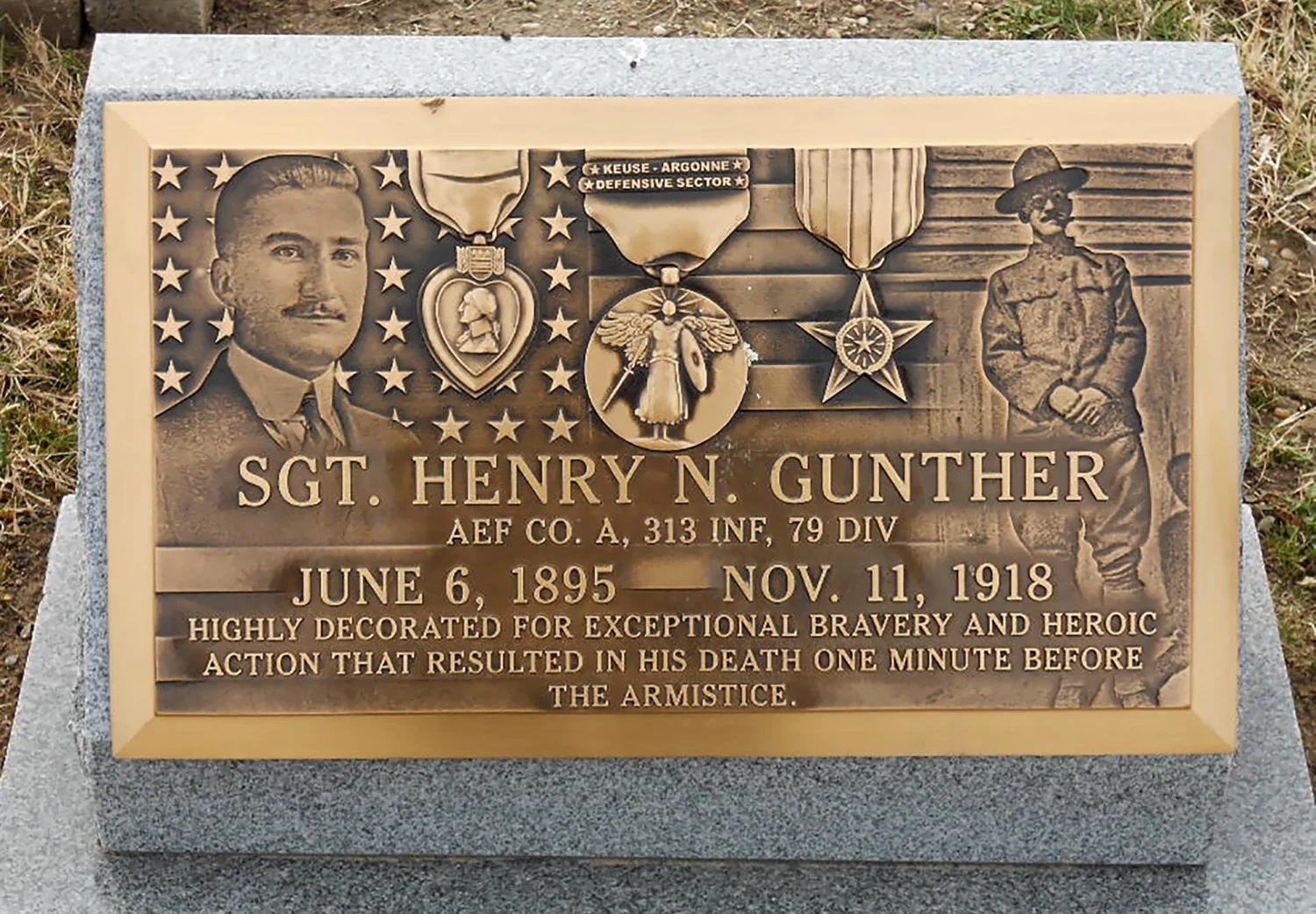
Private Henry Gunther's Grave
The muddy dawn of November 11, 1918, arrived heavy with an unspoken question. Just beyond the splintered parapets and tangles of barbed wire, a hush had settled over the ravaged fields of France, broken only by the tense murmurs and shuffled boots of soldiers waiting for the end. Hours earlier, word had spread through the ranks: at precisely eleven o’clock, the guns would cease. Yet, as the minutes ticked inexorably toward the Armistice, relief mingled uneasily with anxiety—the war would be ending, but not yet. In the final minute before peace, fear sharpened anticipation; every heartbeat sounded like the last. At 10:59 a.m., with victory and safety in sight, Private Henry Gunther did the unthinkable. He rose from the American trenches and surged alone into the crossfire, charging right into bristling German machine guns. In that moment—just sixty seconds before silence—Gunther became the war’s last casualty. Why did he run toward almost certain death, when peace was so close? What compelled him into that desperate charge, as the world waited to exhale and lay down arms? The answer, as elusive as the war’s final bullet, remains etched in the shadowy margin where tragedy meets history.
Henry Nicholas Gunther was, in many ways, an ordinary man—born and raised in a modest Baltimore neighborhood to German-American parents. Before the war, he worked as a clerk at a local bank and was rooted in a close-knit community, sharing the dreams and struggles of countless Americans in the early twentieth century. Yet, history would remember Gunther for a singular, extraordinary moment: on November 11, 1918, with peace just moments away, he became the very last American soldier to be killed in combat during World War I.
To appreciate the full weight of Gunther’s story, it helps to understand the chaotic and draining circumstances of the war’s final hours. For four years, Europe had been consumed by violence on a scale previously unimaginable, leaving its people exhausted and traumatized. In the November gloom of 1918, troops on both sides knew an armistice had been agreed upon, scheduled to take effect at 11 AM. Despite this, fighting persisted right up to the appointed hour—orders were orders, and the chaos of the battlefield rarely allowed for a neat or humane conclusion.
That Henry Gunther died in these final, senseless moments carries immense symbolic weight. His death, coming mere seconds before the guns fell silent, stands as a poignant reminder of both the futility and persistence of war. It encapsulates the tragedy that, even as leaders secured peace, individuals continued to suffer its consequences—until the very last possible moment. Gunther’s story is not simply that of a casualty but of a man whose fate highlights the random and relentless nature of global conflict.
Tracing Gunther’s journey underscores the deeply personal stakes of history. From the familiarity of Baltimore’s city streets, he found himself transported to the mud and wire of France’s battlefields. Along the way, Gunther faced not only the dangers of combat but also personal setbacks—reduced in rank after a misunderstanding, and serving while bearing the weight of disappointing those closest to him. His struggles, both public and private, resonate with anyone confronted by duty, expectation, and the search for meaning amidst chaos. In the end, Gunther’s sacrifice places him among those whose names and stories invite remembrance, ensuring that the cost of war is measured not just in numbers, but in lives lived and lost.
Henry Gunther’s story begins in the vibrant, close-knit neighborhoods of Baltimore, Maryland, where he was born on June 6, 1895. His family was part of the city’s thriving German-American community, an enclave that carried its old-world customs, language, and tight bonds even as it adapted to a new life in America. Henry’s father, George Gunther, and mother, Lina Roth, were both German immigrants, each having arrived in the United States seeking opportunity and stability amid the political and economic uncertainties of late 19th-century Europe. Baltimore offered them solace—a place to raise their family and maintain the traditions they brought from their homeland.
Growing up, Henry was immersed in a rich blend of cultures. The Gunther household likely echoed with conversations in German, but also with aspirations of integrating into American society. Churches, social clubs, and German-language schools formed the backdrop of Henry’s childhood, shaping his values and giving him a strong sense of community. He attended local public schools, including St. Michael’s German Catholic School, where he not only received a general education but also learned about the heritage and values his family cherished. Early on, Henry displayed a quiet determination and sense of responsibility, likely influenced by the expectations of his immigrant parents and the industriousness prevalent in Baltimore’s working-class neighborhoods.
Yet, Henry’s identity as a German-American became complicated as tensions escalated between the United States and Germany during the First World War. Across the country, communities like his faced suspicion and, at times, outright hostility as anti-German sentiment swept the nation. It was a difficult environment; German-language newspapers were shuttered, and families changed their names or Anglicized their customs to avert ridicule or discrimination. Henry, coming of age amid these pressures, had to navigate the duality of his American citizenship and his German heritage. Despite the growing hostility around them, the Gunther family remained proud but quietly vigilant, balancing fidelity to their roots with a cautious embrace of American patriotism.
Baltimore’s German-American community provided support and continuity, even as it faced uncertainty and prejudice. For Henry Gunther, this early life experience—caught between two worlds—would deeply inform his sense of duty, identity, and ultimately, the choices he would make as the specter of war loomed, and he prepared to serve the country he called home.
Willi Günther’s journey to war began not with a surge of patriotic fervor but with a mix of apprehension and obligation. Like many of his generation, he felt the pressure of national expectation and the looming threat of conscription. Ultimately, Günther chose to enlist voluntarily, anticipating more control over his destiny than if he waited to be drafted. Upon joining the ranks, he was assigned the role of supply sergeant—a critical but often overlooked post that required sharp organization and a dependable character. Günther’s initial days were shaped by the gritty routine of military life: endless drills, meticulous paperwork, and the challenge of managing meager resources for his unit. In the barracks, camaraderie flourished out of necessity; soldiers forged bonds over shared cigarettes, sleepless nights, and the rare comfort of letters from home. Yet, beneath this facade of solidarity, a persistent anxiety lingered, fueled by rumors from the front and the unspoken awareness of war’s true toll.
Günther’s service record reveals a diligent, if occasionally outspoken, non-commissioned officer. He executed his duties efficiently but refused to shy away from voicing frustrations about poor leadership and inadequate supplies in private correspondence. It was this candor that precipitated a defining moment in his military career: the infamous letter home. In a letter meant for his family, Günther vented about the shortcomings in command and the harsh realities faced by enlisted men. The letter never reached his family; instead, it was intercepted by army censors who saw his words as a breach of loyalty and protocol. The swift consequences followed—Günther was demoted, stripped of his rank, and subjected to public reprimand. The shame of this fall from grace was compounded by the disappointment of his comrades and the cold scrutiny of his superiors.
Though the experience was deeply humiliating, it forged in Günther a newfound determination. Driven by the weight of disgrace and a desire to restore his reputation, he embraced even the harshest assignments with resolve. The ordeal reshaped his outlook, teaching him the grave implications of truth-telling in wartime and the precarious balance between integrity and survival. In the months that followed, Günther’s resilience and commitment to his fellow soldiers began to rebuild the trust he had lost, setting the stage for the defining challenges yet to come.
After months of anticipation and training, the American troops found themselves transported across the Atlantic, landing at the battered fields of France. The reality of trench warfare struck with immediate force—a world defined by mud-caked boots, interminable boredom punctuated by moments of terror, and a landscape scarred by craters and coiled with barbed wire. For August Gunther and his fellow soldiers, the front lines presented not just the threat of sudden violence, but the grinding monotony of daily survival: keeping weapons clean from the ever-present mud, rationing dwindling supplies, and enduring cold that clung to the bones.
The Meuse-Argonne offensive in November 1918 stands out as the great crucible for American involvement on the Western Front. Eyewitness accounts, along with historical records, paint a picture of chaos beneath the relentless pounding of artillery. Shells whistled overhead day and night, tearing apart the earth and any who wandered above trench level. Gunther’s unit advanced slowly, inch by inch, through forests shattered by shellfire and through fields that had become quagmires. Morale oscillated between grim determination and sheer exhaustion, as casualties mounted and progress was measured in the mere yards gained against entrenched German defenses.
As the offensive ground to its bloody climax, rumors of an impending armistice whispered along the trenches. On the morning of November 11th, 1918, conflicting orders added to the confusion. Some officers pressed their units forward, intent on securing one last foothold, while others hesitated, wary of needless loss in the war’s waning moments. The atmosphere became surreal, charged with a frantic energy as word of peace trickled down the line. Gunther’s comrades swapped disbelieving glances, straining to catch distant sounds that might signal the end—church bells, shouted orders, or even the sudden hush of guns. In these final hours, the Western Front was a place of uncertainty, anxiety, and hope. Men questioned whether it was safe to hope, whether the armistice would hold, whether they had truly survived the war’s fury. For many, the last day was the most perilous, the lines between duty, chaos, and relief blurring as the world hovered at the edge of peace.
At precisely 10:59 a.m. on November 11, 1918, with barely a minute left before the long-awaited Armistice would end four years of bloodshed, Private Henry Gunther began a charge that would etch his name into history. Eyewitness accounts from soldiers on both sides, as well as official military reports, reconstruct those harrowing last moments on the Western Front near the French village of Chaumont-devant-Damvillers. According to fellow doughboys from the 313th Infantry, Gunther’s action seemed to come suddenly, without clear command—he leaped from the trench and advanced steadily toward a German machine-gun nest. German soldiers, fully aware that peace was imminent and that hostilities would end in seconds, reportedly shouted and waved at Gunther, frantically signaling for him to halt, but he pressed on undeterred.
Analysis of Gunther’s motivations remains a source of debate among historians. Some suggest that a profound sense of personal redemption drove his final, fatal dash: a recent demotion amidst rumors and misunderstandings had weighed heavily upon him, leaving him eager to prove his valor not only to his comrades and superiors but perhaps even to himself. Others believe miscommunication played a role—uncertainty about the precise timing or enforcement of the ceasefire, or possibly the chaos of battle masking any orders to cease advancing. Still, the emotional toll of countless months in the trenches cannot be underestimated; Gunther, like many men in those final hours, may have felt a combination of relief, nervous energy, and confusion, with adrenaline compelling him to act.
As Gunther neared the barbed wire and the German position, the German machine gunners, at first reluctant, fired a short burst, striking him. Several reports detail how he collapsed just as the church bells in nearby villages began to peal at 11:00 a.m., heralding the end of the war. Gunther thus became the last American—and widely considered the final Allied—soldier killed in combat seconds before peace officially resumed. The tragedy of his death was not lost on the German defenders, who, according to later interviews, expressed deep regret, unable to stop fate in those fateful final seconds. Gunther’s charge and sacrifice serve as a poignant symbol of war’s senseless final casualties, occurring even as silence and peace settled over the scarred battlefields.
News of Henry Gunther’s death, delivered with the grim irony that peace had just been declared, sent waves of shock and sorrow through his battalion. His fellow soldiers and commanding officers, who only moments before had experienced the collective relief and euphoria of war’s end, were suddenly confronted by the bitter reality of loss. Accounts suggest that the men were devastated—some reported feeling that Gunther’s death was especially tragic since it occurred a mere minute before the armistice took effect. For many, it underscored the senselessness and random cruelty of conflict, imprinting Gunther’s sacrifice indelibly on their memories.
Official military channels reacted with solemn dignity. At first, Gunther’s prior demotion—a result of a letter home expressing his war-weariness—cast a faint shadow over his record. Yet, in recognition of the extraordinary circumstances and the poignancy of his death, the U.S. Army posthumously restored his previous rank of sergeant. This administrative correction served not just as a gesture of respect for his bravery, but also as an attempt to assuage the grief of his family and unit. Letters and telegrams were sent to his relatives in Maryland, offering not only condolences but also assurances that his sacrifice had not gone unnoticed. The tone of these communications reflected both the personal loss felt by those who knew him and the broader tragedy of lives lost just as peace reemerged.
Over time, the legacy of Henry Gunther has grown more resonant. In his hometown of Baltimore and across Maryland, he is remembered as both a son and a symbol. His grave, marked at Most Holy Redeemer Cemetery, has become a site of local pilgrimage, and each year, veterans’ groups and historical societies lay wreaths or hold moments of silence in his honor. Memorials, including plaques and brief biographies in public spaces, keep his story alive as a tangible reminder of the cost of war and the persistent hope for peace. Gunther’s name is read aloud at commemorative services marking the end of World War I, ensuring that the memory of the last American—and one of the last soldiers overall—to fall in the conflict remains a poignant warning and tribute for future generations.
The story of Henry Gunther’s death has drawn extensive reflection from historians, who see in it a powerful symbol of both the senselessness and the gravity of war’s closing moments. Gunther’s death—occurring just one minute before the Armistice of November 11, 1918, took effect—has become a poignant narrative motif for the arbitrary nature of battle’s end. Many scholars have remarked on the symbolism: with peace already agreed upon, the continued exchange of fire underscores not just the chaos of war but also the difficulty of drawing a definitive line between conflict and cessation. In Gunther’s final charge, there is a haunting echo of all those who perish just as hope or resolution appears on the horizon, offering a stark reminder of the random and sometimes cruel timing of war’s toll.
Beyond mere chronology, Gunther’s fate also resonates with broader themes: the price of conflict, the anonymity of sacrifice, and the deep personal costs that ripple through families and communities. His story is often cited on Armistice Day—now Veterans Day in the United States—as a focal point for reflection on the collective loss endured during wartime and the uneasy transition to peace. Each year, as memorial ceremonies observe the moment guns fell silent, Gunther’s name surfaces as both a symbol of ultimate sacrifice and as a call to remember the individual stories obscured by larger historical narratives. His memory persists in communities such as Baltimore, where commemorative plaques and remembrances by local veterans’ groups underscore the enduring impact of his story.
Personal anecdotes from Gunther’s descendants and community members further shape his legacy. Family accounts recall not only the man behind the uniform—a son, a brother, a member of a tight-knit immigrant community—but also the generational reverberations of his early and tragic death. Modern reflections, especially among those descended from World War I families or engaged in veterans’ advocacy, often return to the idea that Gunther’s story speaks for countless others whose lives were cut short in war’s final hours—reminding us that even as history moves forward, the human cost of conflict remains, urging continual remembrance and reflection on the meaning of service and sacrifice.
Henry Gunther’s story looms large as both an intimate tragedy and a universal symbol of war’s caprice. His fate—a lone soldier falling in the war’s waning seconds—is almost unbearably poignant. In that brief, fatal moment after peace had technically been secured, Gunther becomes more than just a name on a memorial; he embodies the countless ordinary men whose lives were swallowed by war’s inexorable machinery. His passing, lost in the final minutes before armistice, captures the heartbreak of lives cut short not for strategy or victory, but due to the relentless, impersonal momentum of conflict. For every general celebrated in textbooks, there are myriad Henry Gunthers—those who marched, hoped, and perished, often without acclaim.
Gunther’s legacy is thus inseparable from the larger tapestry of sacrifice that defines the First World War. His story stands as a solemn reminder that history’s turning points are not tidy or predictable, but woven from fleeting, deeply human moments. The tragedy of his death at 10:59 a.m. on November 11, 1918, just one minute before the guns at last fell silent across Europe, underscores the lingering chaos and unpredictability of war. It brings into sharp relief the personal costs hidden behind every public commemoration or grand historical narrative.
Today, remembering Henry Gunther means more than recalling a single name; it serves as an invitation to see every soldier and civilian caught in conflict as individuals, not mere statistics. In the ceremonies and quiet acts of remembrance that follow each anniversary of the armistice, Gunther’s story prompts us to humanize the past—to glimpse the hopes, fears, and individuality of those who shaped history by living and dying within its tides. His quiet echo reminds us that true remembrance lies not only in honoring renowned heroes, but in acknowledging those whose stories are softer, almost inaudible amid the clamorous sweep of history. As we look back on the Great War and the price paid by so many, let us strive to ensure the Henry Gunthers of the world are never forgotten—the quiet witnesses and final sacrifices whose experiences still shape our understanding of war, memory, and human loss.